
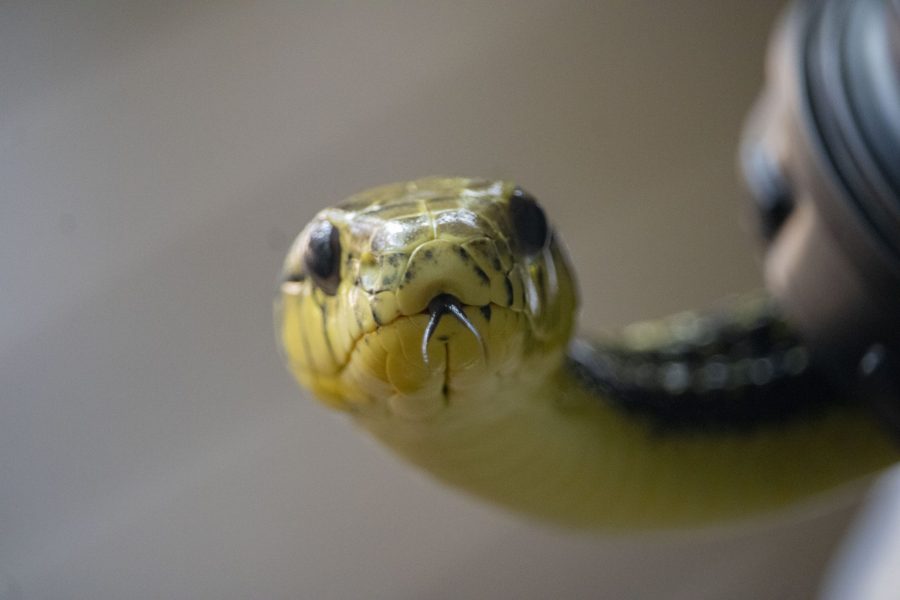
Meet Amazon puffing snake, Gerald.
Happy World Snake Day! Our Zoo is home to nine species of snakes, each of which serve as ambassadors for their counterparts in their native ranges. Snakes play such an important part of their ecosystems, as both population control for small rodents and other creatures, and sometimes as a prey item for larger animals.
Besides their incredible role in our world – snakes can have some incredible personalities as well. We asked our Animal Ambassador and Herps & Aquatics teams to share a bit more about some of these animal residents below.
Amazon puffing snake
About this species: Native to South America, Amazon puffing snakes are arboreal, or tree-dwelling.
Our residents: Amazon puffing snake Gerald is one of the most inquisitive snakes currently residing in our Venom House, said Herps & Aquatics keeper Kaitlyn. Gerald enjoys watching his keepers work through the window if the habitat door is closed.
Where to see him: Gerald can often be seen scaling the walls of our Venom House habitat in Rainforest Revealed.
Annulated tree boa
About this species: A nocturnal, non-venomous species, annulated tree boas can often be found in the trees of their native range of Central America.
Our resident: As a nocturnal snake, Penny can be hard to spot as she loves to rest under hides in flat spaces, said Herps & Aquatics keeper Grey. You can most often find her on the flat round PVC board to the right of the center window.
Where to see her: Venom House in our Rainforest Revealed loop is Penny’s home!
Ball pythons
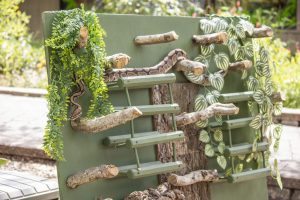
About this species: A species native to Africa, ball pythons are the smallest python species. Pythons have heat sensing pores on their upper mouth called labial pits, which allows pythons to see a thermal image of their area.
Our residents: We’re home to Simon (estimated to be about 30 years old) and a younger python named Garfunkel, whose been at our Zoo for 3 years.
Simon is a very sweet snake who will mostly stay curled in a ball while being held, Jenna said. As a nocturnal animal, Simon spends most of his day sleeping in his habitat.
Garfunkel is more active than Simon, and he loves to explore enrichment and new things in his habitat – especially climbing structures.
Where to see them: You can potentially see these Ambassador Animals at a Zoo event or program.
Burmese python
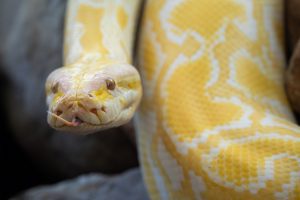
About this species: These large nonvenomous snakes are native to parts of Asia, but they are well-known as an invasive species in Florida after pet Burmese pythons were either intentionally or accidentally released. It’s important to do your research before taking in any animal as a pet. While Burmese pythons are an important part of the ecosystem in their native range, they harm Florida’s ecosystem and native animals.
Our resident: A recent addition to our Zoo, Al Dente is an 11-foot, albino Burmese python. A curious fellow, Al Dente usually sticks his head out of wherever he’s resting whenever keepers enter his habitat – he just wants to know what’s going on, said Herps & Aquatics keeper Alec. Al Dente loves to soak in his pond overnight as well.
Where to see him: Al Dente’s home is in our Expedition Africa loop
Emerald tree boas
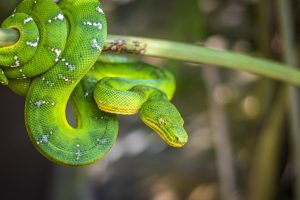 About this species: Emerald tree boas are native to South America. They give birth to live young (oviviparous) instead of hatching young from eggs – and our two emerald tree boa males are both potential sires to two sets of emerald tree boa snakelets born at our Zoo in 2022 and 2023.
Our residents: Hunter and Forest are two of our male emerald tree boa residents. Hunter is the more adventurous of the two and is usually one of the first to react to new scents or enrichment in his habitat, said Herps & Aquatics keeper Kaitlyn. As a nocturnal species, Forest isn’t active much during the day, spending most of his time curled up on perching observing the other inhabitants and waiting for it to get dark to explore around himself.
Where to see them: Check out our Venom House habitat in Rainforest Revealed!
Eyelash vipers
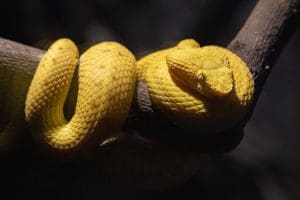
About this species: One of the smallest venomous snakes in their native habitat of South America, eyelash vipers can be easily recognized by their triangular head and bristly scales above the eyes.
Our residents: Our female eyelash vipers Dandelion and Gold can normally be seen in a cuddle-puddle high up in the habitat, said Herps & Aquatics keeper Kaylee. They are a nocturnal species so you may not see them doing much more than sleeping during the day, but during overnight monitoring we can see them explore their whole habitat. In the winter when the weather is slightly cooler, they tend to sleep right under their heat lamps while in the summer they can be seen sleeping in a pile of cool, damp moss.
Where to see them: These two share their own space in Rainforest Revealed’s Venom House.
Kenyan sand boas
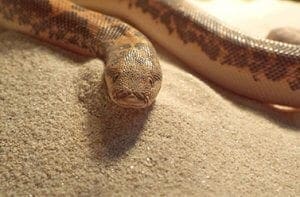 About this species: Native to Africa, this species prefers sandy soil typically found in desert or scrub ecosystems. Their eyes are on top of their heads to see above the sand, and their tails actually don’t coil. They feel different to handle said Ambassador Animal keeper Jenna – almost like a worm!
Our residents: Our family group – Walter, Matilda and Beetlejuice (daughter of Matilda and Walter) – live in our Zoo’s behind-the-scenes Wildlife Discovery Hub.
This nocturnal trio loves to spend their days burrowed under their sand. They don’t interact with enrichment much – but our animal care team has had success bringing them to different substrates.
Where to see them: You can potentially see these Ambassador Animals at a Zoo event or program.
Red rat snakes
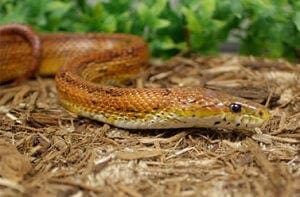 About this species: Found throughout the eastern U.S., corn snakes were threatened in their native range once because of collection for the pet trade. It’s always important to do your research before adopting a pet.
Our residents: Three red corn snakes are a part of our Animal Ambassadors!
Hissy Elliott loves a hanging hide and new perches or plants!
Justin Timbersnake is very active, he loves to check in with his animal care team while they’re cleaning his habitat.
Mango loves piles of moss or hay in her habitat – and sometimes slithers through them.
Where to see them: You can potentially see these Ambassador Animals at a Zoo event or program.
Tiger Rat Snakes
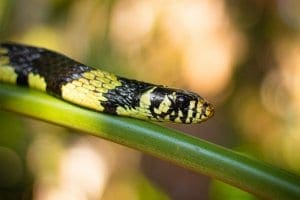 About this species: This nonvenomous snake is native to Central and South America.
Our residents: We are home to three adult tiger rat snakes: Carol, Wanda and Tony. Carol spends most of her time high up on the perching or on a ledge underneath a basking lamp, sometimes even cuddled up in a pretzel with another Tiger Rat Snake, Alec said.
Tony and Wanda are the proud parents of six snakelets hatched this year, a first for our Zoo! Tony loves to spend time with our Amazon puffing snake, Gerald. He also actively seeks out misting opportunities when offered, said Herps & Aquatics keeper Kaylee – and he loves a good soak.
Wanda can often be found up high in her habitat unless there is an enrichment hide – then she will choose to spend her time there. One of her favorite hides is a large green ball with lots of holes. She sometimes can be found sharing it with the other female tiger rat snake Carol.
Where to see them: You can find our adult tiger rat snakes at our Venom House in Rainforest Revealed.