
Searching for seeds is like looking for a needle in a haystack.
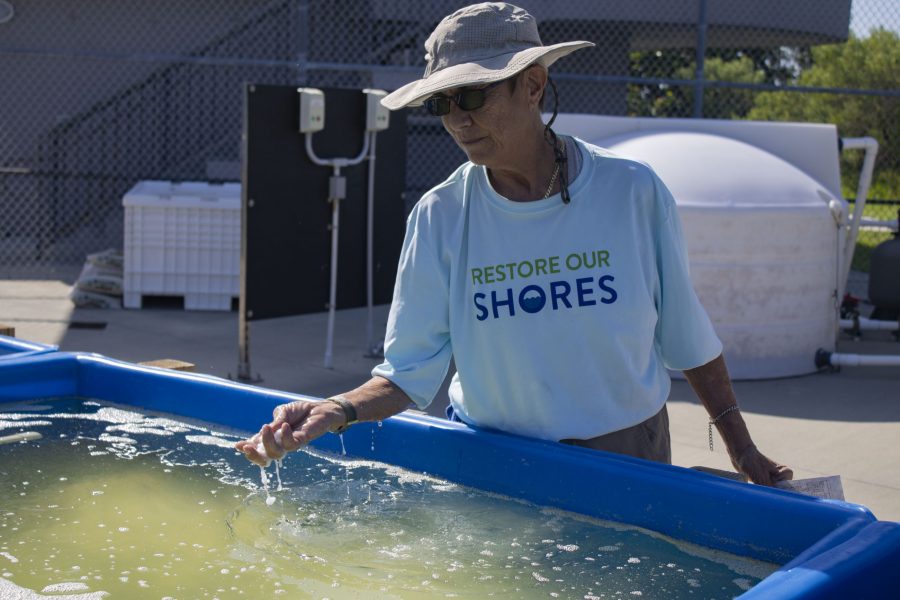
You may know about our East Coast Zoological Foundation’s Restore Our Shores program’s extensive research efforts to learn more about reintroducing native seagrass beds back into the Indian River Lagoon, but we don’t often share the complex science that goes on behind the scenes.
Our teams are on the cutting edge of research when it comes to Halodule wrightii, the primary species used for seagrass restoration in the lagoon, including looking at the impact of herbivory exclusion and seagrass microbes on planting success. Currently, we are looking into how Caulerpa prolifera, a type of local macroalgae, affects seagrass growth and sediment composition. We’re thankful for our partnerships with the University of Central Florida, University of Lausanne and Florida Institute of Technology for teaming up with us on these studies.
While Halodule wrightii is historically one of the most abundant species in the lagoon, its reproductive capabilities and life cycle are not fully understood. It has been thought that it’s mostly spread by asexual fragmentation, where new plants can form from pieces of the parent plant. Flowering and seeding events have also been observed in the lagoon, although much less frequently.
Since it’s uncertain what prompts Halodule wrightii to flower or seed, how viable their seeds are or how long they take to reach maturity, anything we learn in the nursery could be valuable for restoration work and further seagrass growth optimization!
So far, we’ve conducted one collection event to look for seeds in our seagrass nursery, which primarily grows Halodule wrightii. It took three days to search through the samples and identify if seeds were present. It’s tedious work trying to identify seeds – which are 2 millimeters in size – amongst the gritty sediment. However, after hours of work, the team was able to find three seeds. While that may not sound like a lot, in this stage of the study, any kind of information that can be gleaned from these small seeds is important!
“Being able to see a flowering event at our nursery was an exciting experience,” said conservation manager Tyler. “Since we have the right conditions for these events to occur, we were able to observe something that’s relatively understudied in our system. It could be difficult to replicate, but we think now is the time to try.”
Going forward, we hope to look for seeds on a quarterly basis. We are planning on conducting testing both in our research tanks at the nursery as well as at the team’s office space where it’s easier to manipulate variables and have greater control. We’ll be seeing if we can prompt flowering events and eventually seed germination and viability once more seeds are uncovered.
“We’re excited to keep learning about Halodule wrightii and hope to have some cool results to share with you in the coming year,” said Tyler.
Brevard Zoo is an independent, not-for-profit organization that receives no recurring government funding for our operating costs. Your generous support enables us to continue to serve our community and continue our vital animal wellness, education and conservation programs.
We would like to thank the following generous donors for supporting our Restore Our Shores programs:
Flammio Financial Group · Stifel- Garvin Wealth Management Group · Artemis IT · Pepsi Bottling Company · Amazon · PCL Construction | Nassal | MEC | Heard · Brewer Paving and Development · HHCP Architects · Boys Electrical Contractors · SSA Group · AOA