
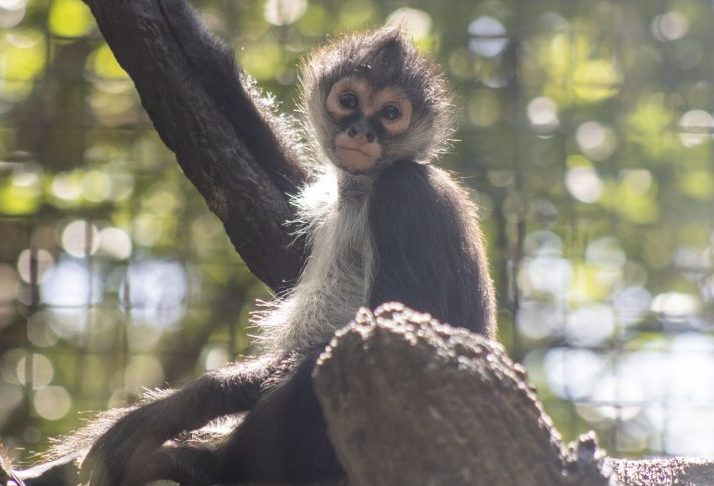
A 2022 photo of J the black-handed spider monkey.
It’s with heavy hearts that we share our 5-year-old black-handed spider monkey, J, was euthanized this weekend after sustaining extensive injuries during an altercation among our spider monkey troop.
The dynamics of a primate group can be ever-changing and complex. Our spider monkey troop is heavily monitored not only by our own animal care team, but also by Florida Tech’s Animal Research Team. No aggression toward J had been seen from any other members of his troop in the weeks leading up to this altercation, which appears to have happened in the early morning hours before our Rainforest Revealed animal care specialists were on-site. Cameras in this area did not capture the altercation.
On March 23, J was brought to our L3 Harris Animal Care Center after being found with significant wounds. After our veterinary team cleaned and stabilized his wounds, J spent the next several days receiving around-the-clock care from his animal care team, who was focused on his comfort and quality of life. J was placed on multiple pain medications and broad-spectrum antibiotics, and he appeared to be recovering well until March 28, when a few of his wounds reopened. During a second exam, our veterinary team found evidence of an intensive infection in several wounds that had reached the bone. After weighing what further treatment might mean to J’s quality of life, our veterinary team made the difficult and compassionate choice of euthanasia to protect J from future suffering. A necropsy found evidence of even more extensive infection and tissue damage.
With no human witnesses, it’s difficult to pinpoint what happened to cause what we suspect was an altercation that involved multiple members of our troop. This aggression may have been tied to shifting dynamics with an emerging alpha male and female in the troop. We are continuing to closely monitor the troop, which has reverted to their typical behavior.
Animals communicate and interact in ways that we, as people, can never entirely understand. We work to understand our animal residents’ behaviors and interactions as best we can, always with the goal of supporting their wellbeing. Aggression can be used as a tool to communicate among primate species, and it’s possible the troop took “correcting” J’s behavior too far.
Our animal care team is working with our colleagues at Association of Zoos and Aquariums (AZA) organizations and other behavioral experts to identify additional ways to ensure the safety of all members of our troop. As we continue exploring these options, additional cameras are being placed in spider monkey habitats and their nighthouse to allow our animal care experts to observe troop behavior overnight.
We are in a unique situation – no other organization accredited by the Association of Zoos and Aquariums (AZA) has a troop of our size, about 15 monkeys. Our spider monkey habitats’ unique setup with multiple habitats connected by sky tunnels makes it possible for us to be home to a large troop with sufficient space and options for troop members to break away from the group as needed.
Our troop is also unique in that about one-third of its members, including J, are victims of wildlife trafficking. Because these monkeys were taken from their familial troop as infants, they don’t have the skills to live back in their native range, making an AZA-accredited zoo their forever home.
The wellbeing of all of our animal residents is of critical importance to everyone at our Zoo. We know how difficult this news is to process, and we are profoundly grieving the loss of J.
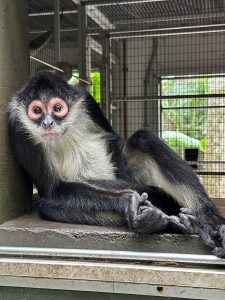
A photo of J from Americas keeper Sadie.
J came to our Zoo in 2021, after being confiscated at the United States-Mexico border when someone was caught attempting to smuggle him into the country in a suitcase. It’s impossible to know exactly what J’s life was before he was rescued, but there are anecdotes to understand the conditions and poor outcomes trafficked animals face.
It was our privilege to give J a home where he could live his life as naturally as possible with fellow monkeys, have choice and control over his day, and build relationships with an animal care team who is equipped to care for this special species.
J’s playful, curious spirit will be remembered fondly by our Zoo. He brought so many smiles to his animal care team, shared Americas keeper Sadie. From his funny way of jumping up and down on all fours when he was feeling energetic to his upright Jack Sparrow-esque saunter, he “had so much personality and was a very big presence in the troop,” Sadie shared.
Often, J’s love of play would extend to the younger members of his troop – and even to his keepers. For Americas keeper Dani, playing “tag” with J was a highlight of her day. From his habitat, J would vocalize and run back and forth with her.
“This simple behavior always cheered me up, no matter what was going on in my day,’ Dani said. “Working with J was such a privilege; I learned so much from him and I will miss him deeply.”