
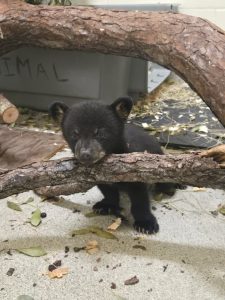
Meet Scruffy, one of our three patients!
Editor’s Note: The Florida Fish and Wildlife Conservation Commission’s (FWC) Bear Management Program works closely with Brevard Zoo and other partners to ensure orphaned black bear cubs not yet able to survive on their own are given the best chances at successful rehabilitation and eventual release back into their natural habitat. The FWC aims to release rehabilitated young bears on public conservation areas that have high quality bear habitat and low density of both bears and people to give them the best chances for survival.
Bear cub season has officially kicked off at East Coast Zoological Foundation’s Brevard Zoo! Over the last year, we successfully released 17 Florida black bear cubs back to their native ranges after months of rehabilitation at our Black Bear Rehabilitation Center.
Now, we’re ready to do it all over again — starting with this year’s first rehabilitation patients: Sammy, Scruffy and Grape.
First came Sammy, a small male cub who is estimated to be just a few months old. When the Florida Fish and Wildlife Conservation Commission (FWC) Bear Management team found Sammy all alone in the Florida Panhandle, they transported the thin cub to our Zoo’s L3 Harris Animal Care Center.
On top of being underweight and covered in ticks, Sammy seemed to be struggling to use his limbs properly. It was thought he potentially had tick paralysis, which cleared up in a couple of days after all the ticks were removed.
Our veterinary team also performed a full examination including X-rays and bloodwork to investigate his mobility problems further, and with some time and rest, he’s back to normal.
Along with Sammy came another orphaned cub: a 4-pound female cub found on the roads of Ocala National Forest. After observing the lone cub, a partner agency reported the sighting to FWC for assistance. Its Bear Management team brought the cub, who we’re calling Scruffy, into our care alongside Sammy. Fortunately, we don’t think Scruffy had been on her own for long as she arrived in relatively healthy condition.
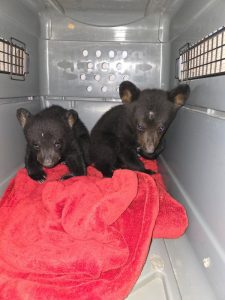
Scruffy (left) and Sammy (right) on their way to our Zoo following their rescue
Finally, we welcomed Grape, a 5-pound male cub. Deputies from the Marion County Sheriff’s Office found this little cub wandering Ocala National Forest alone. After the deputies safely passed the cub over to FWC’s Bear Management team, Grape came into our care.
Aside from needing the usual nutrition and weight boost, Grape seemed to have a small injury to one of his front limbs. But after some proper rest and food, he seems to be feeling better.
Because these cubs are still young and tiny, they have some growing to do before they’re ready to be shifted into our behind-the-scenes Black Bear Rehabilitation Center. Our current priority is boosting all three of the cubs’ weights with a formula-based diet and encouraging plenty of rest.
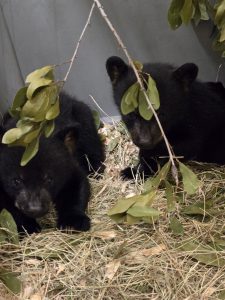
Scruffy (left) and Grape (right) hanging out together
Younger cubs, like Scruffy, Sammy and Grape, are more impressionable than older ones — meaning they naturally have a higher chance of imprinting on the humans who care for them.
Our bear care staff disguises themselves in masks and ghillie suits, avoids speaking aloud and keeps a loud fan buzzing in the background to reduce any sounds of their actions while delivering food to ensure the cubs do not associate humans with food during these developmental months.
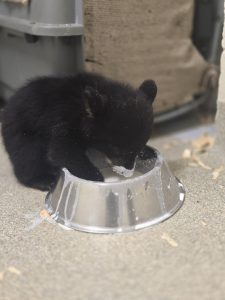
Scruffy practices drinking formula from a dish in our L3 Harris Animal Care Center
We’re continually grateful to give these cubs a second chance in life. Bears play such an important role in their ecosystem, so every cub saved is a win in preserving and protecting the Florida black bear species.
Check back with our blog and social media channels for updates!
Please contact the FWC’s 24-hour Wildlife Alert Hotline right away at 888-404-FWCC (3922) if you have found an orphaned, sick, injured or dead Florida black bear.
Special thank you to Pat McMahon and Bob Mansbart for their contributions toward our Black Bear Rehabilitation Center, affectionately known as Brody Bear’s Rescue and Rehab.