
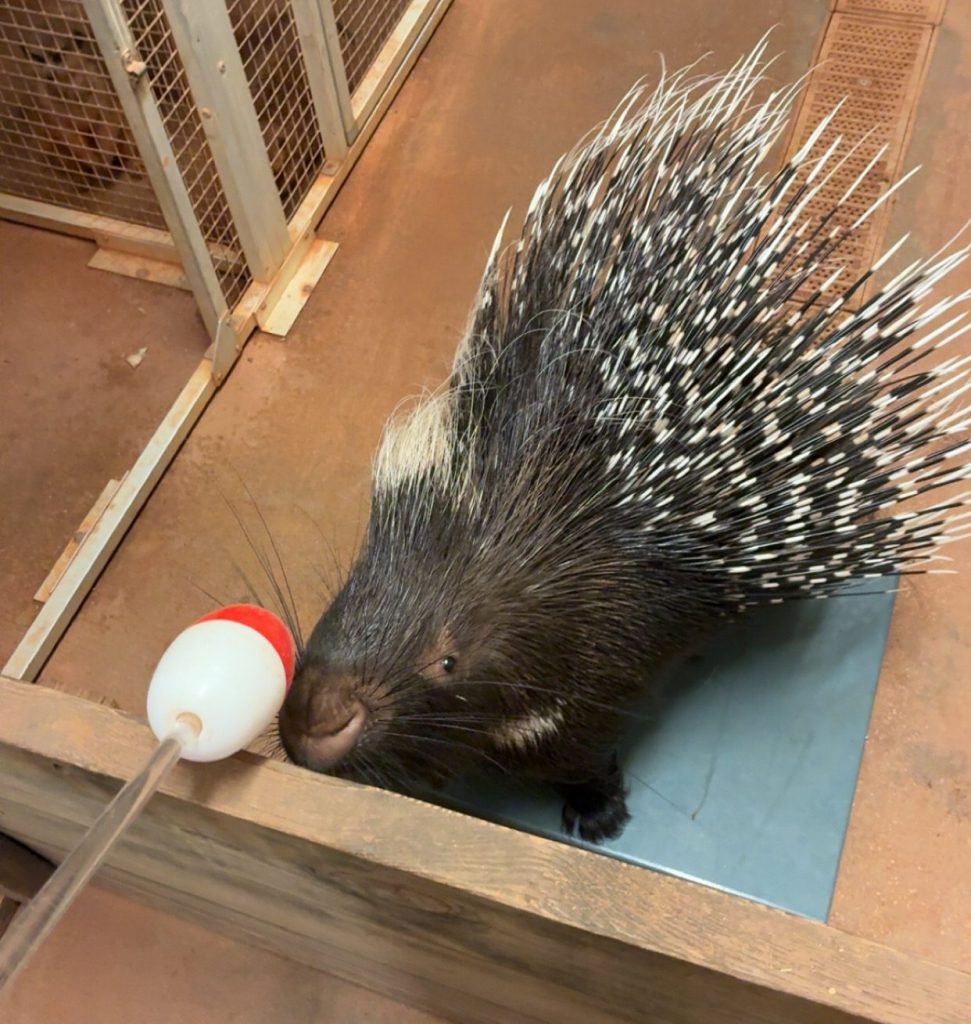
Loki enjoys participating in training sessions with his keeper, Kim!
If you’ve visited the Zoo, you’ve likely met a lot of our more than 700 animal residents. Some animals are easy to spot, but others are often not as easy to see because of their habitat set up, their personalities or their sleep cycles among other things. We wanted to start a Meet the Animals section of our blog to introduce you to some of the residents that you may (or may not have) met yet!
Our meerkat habitat is a must-visit when meandering through our Expedition Africa loop. While you may have observed our meerkat mob through the glass several times, you might have missed the biggest, and shyest, resident in this mixed-species habitat. Meet Loki our 3-year-old Cape porcupine! As a nocturnal animal, Loki can be a bit tricky to spot for Zoo goers. However, this quirky, quill-y porcupine is worth getting to know.
“He’s very sweet and curious but also has a sassy side to him,” said Expedition Africa keeper Kimberly. “He can sometimes take time to warm up to new people, but once he does, he’s so much fun!”
His endearing personality has earned him plenty of loving nicknames from his keepers over the years, including Loki Poki, Lokily Pokily, Lokes Ma Pokes and Mr. Poki.
This species’ native habitat spans a wide swath of Southern and Central Africa, residing in countries from South Africa all the way up to Uganda. They typically reside in forested regions, where these herbivores feast on fruits, roots and other vegetation.
Cape porcupines are the largest porcupine species in the world and the largest rodent species on the African continent. They use their large, ever-growing teeth to strip bark and dig up roots, which in turn helps their native habitats. Cape porcupines are ecosystem engineers whose chewing habits help remove old parts of trees and woody plants, promoting new growth. Their pruning instincts also help create habitat for small animals that take shelter in the crevices.
Loki came to our Zoo as a 1-year-old porcupette from another Association of Zoos and Aquariums (AZA) accredited organization. While Loki and his meerkat habitat-mates are often up at different times of the day, they do occasionally check one another out. They’ll investigate each other’s food and enrichment items and sometimes steal the heating pad spot from one another. However, most of the time they are very good habitat-mates who respect one another’s space. Loki is good with enforcing his boundaries and will let the curious critters know if they’re getting too close.
As a nocturnal animal, Loki spends the majority of the day sleeping in his night house. However, he will emerge for feeding time in the early mornings and evenings and for the odd snack or two. Loki also participates in training sessions with his keepers during the day. He knows a variety of important behaviors, including targeting and climbing onto a scale for monthly voluntary weights. He also knows how to climb into a secure carrier to make vet trips easier and less stressful.
“He is typically eager to participate in training, but if you don’t have good snacks for him, he’ll go lay down and go to sleep,” said Kimberly. “However, sometimes he wants to keep training even after running out of snacks!”
Loki’s favorite treats to get are sweet potatoes, apples and biscuits.
Overnight, Loki gets busy interacting with his enrichment items. Being the large rodent he is, he especially enjoys chewing on large logs and branches! Shredding up cardboard and paper enrichment is also a favorite activity.
Loki’s fun-loving personality has made him a favorite among Zoo staff and visitors. If you want the best chance at seeing Loki, arrive at his habitat as soon as the Zoo opens or just before closing. He’ll likely be investigating his breakfast or getting ready for a cozy nap.
Brevard Zoo is an independent, not-for-profit organization that receives no recurring government funding for our operating costs. Your generous support enables us to continue to serve our community and continue our vital animal wellness, education and conservation programs.
We would like to thank the following generous donors for supporting our mission-based programs:
Flammio Financial Group · Stifel- Garvin Wealth Management Group · Artemis IT · Pepsi Bottling Company · Amazon · PCL Construction | Nassal | MEC | Heard