
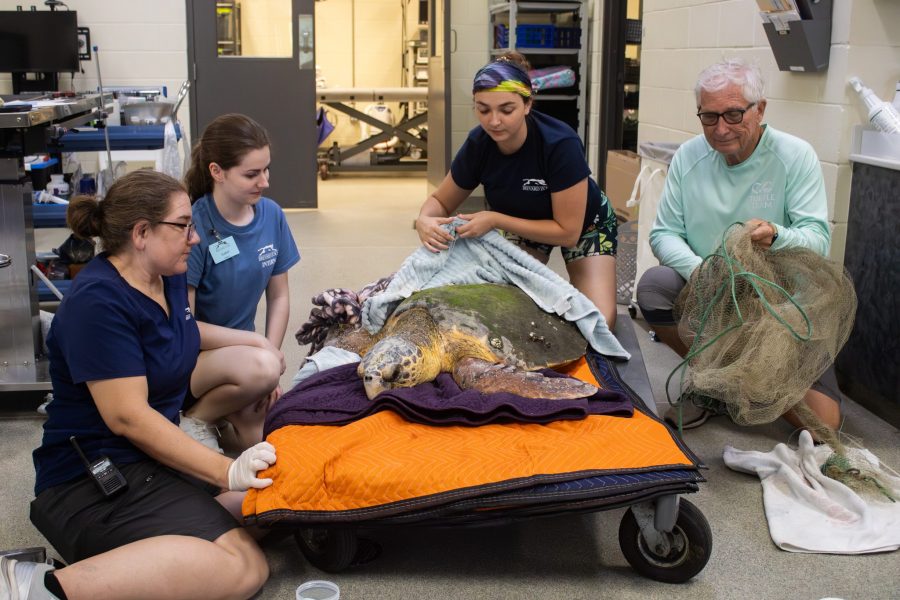
Falafel the loggerhead sea turtle is still recovering at our Sea Turtle Rehabilitation Center.
Fishing hooks puncturing a gastrointestinal tract. Propeller marks on a carapace. Fishing line wrapped around flippers.
Over the last few months, three loggerhead sea turtles have come to East Coast Zoological Foundation’s Sea Turtle Rehabilitation Center after being injured by derelict fishing gear. Unfortunately, we’ve had to say goodbye to two of them in an effort to prevent them from suffering from their extensive injuries.
Derelict fishing gear is one of the major threats facing sea turtles today. While sometimes the effects of this gear is immediately obvious, other times the true impacts are just below the surface.
Sophia the loggerhead came to our Sea Turtle Rehabilitation Center for care.
Sophia the loggerhead sea turtle arrived at our Rehabilitation Center in May after being found stranded in the Indian River Lagoon with fishing line attached to a hook sticking out of their mouth. We were soon horrified to learn that the 140-pound sea turtle had about 18 more fishing hooks lining her digestive tract. Despite our best efforts to remove those hooks, including bringing in Orlando Health Melbourne Hospital with more specialized equipment and collaborating with one of their gastroenterologists to try to save Sophia, we were hopeful that Sophia would return to the ocean. However, after a subsequent surgery partnering with the veterinary team to try to retrieve more hooks, we learned that Sophia’s gastrointestinal tract had been irreparably damaged, and we opted to protect her from further future suffering.
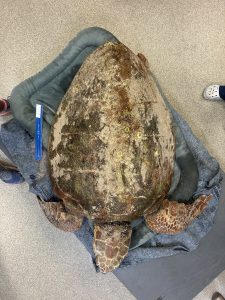
This is an intake photo of Liberty the loggerhead.
July Fourth weekend brought Liberty the sea turtle to our Rehabilitation Center courtesy of Coastal Connections, Inc. This 210-pound adult gravid (with eggs) loggerhead had already survived a boat strike, with presumed healed propeller marks on their carapace. Liberty came to us with a braided fishing line – not only wrapped around their neck and front flippers – but also wrapped around a fellow deceased sea turtle. While our team did their best to salvage both flippers, Liberty’s injuries became too extensive for a return to the ocean. We said goodbye to this incredible sea turtle, knowing we did our best on their behalf.
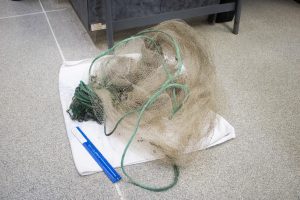
This fishing gear was found attached to Falafel the loggerhead.
Our Rehabilitation Center is still a temporary home for Falafel the sea turtle, who was found with fishing line wrapped twice around their left front flipper, constricting blood flow. An abandoned cast net was also entangled around Falafel. This “ghost gear,” or abandoned fishing equipment, made it necessary to amputate one of Falafel’s flippers. Falafel is making guarded progress now, and we hope to one day return this sea turtle back to the ocean.
It’s always difficult to share these stories of sea turtle patients who never make it home to their natural environment. We hope by doing so, we can inspire our community to continue taking part in protecting this incredible species. Here are a few ways to help sea turtles:
One amazing thing to keep in mind: By taking these steps to reduce our negative impacts on our world on behalf of sea turtles, we actually help more species, including ourselves, to live in a safe, cleaner environment.