
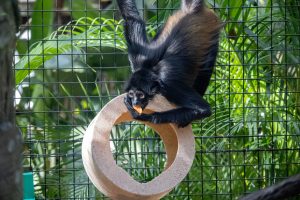
Mateo was rescued as an infant in 2020 after an attempt to smuggle him across the United States-Mexico border. Now, the 6-year-old black handed spider monkey lives among his troop at our Zoo.
At first glance, the video seems harmless — a baby monkey wearing pajamas, drinking from a milk bottle and cozying up on a couch. Social media is flooded with content like this, inviting millions of likes, oblivious reposts and comments of adoration saying, “I need one!”
Oftentimes, when people think of wildlife trafficking, their minds dart to big-name, controversial offenders featured in the media and sensationalized documentaries. But what some may overlook is just how dangerously everyday social media content normalizes the illegal pet trade and fuels the demand for wildlife trafficking around the world.
Our Zoo has become a hub for wildlife trafficking victims over the past few years — from black-handed spider monkeys to Gulf Coast box turtles. We see the firsthand consequences of removing animals from their native habitat for a new setting that doesn’t meet their socialization, diet, physical or enrichment needs.
Take our two most recent spider monkey confiscations, for instance. U.S. Fish and Wildlife Services (USWFS) brought Fernando and Honey to our Zoo after they had been taken from their respective mothers at infancy.
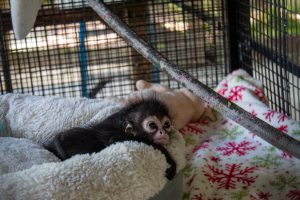
Fernando was just three months old when he came to our Zoo.
Because Fernando and Honey missed out on formative behaviors that spider monkey babies typically learn from their mothers, it was up to us to rebuild these natural instincts and create as comfortable of an experience for them as possible at our Zoo.
After much time, dedication and patience from our animal care team, the monkeys slowly came out of their shells and began interacting with our other spider monkey residents. Now, they are fully integrated members of our Zoo’s spider monkey troop.
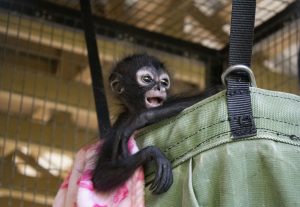
Honey was about five months old when she arrived at our Zoo after her confiscation.
Wildlife trafficking can have dire consequences for ecosystems as well. Close to 75% of the world’s primate species are faced with extinction, cites a recent news release from the Association of Zoos and Aquariums (AZA). Removing primates from their native ranges exacerbates this issue — every plant and animal plays an important role in their ecosystem, and removing them from their natural habitat causes a cascade of problems.
To make matters worse, a significant number of primates that you see for sale online are infants who are often taken from their mothers in their natural habitats.
“People are falsely led to believe that infant primates will bond more readily with humans,” the release states. “Sadly, many of these primates suffer lifelong trauma or die before they ever reach the buyer due to the harsh and dangerous smuggling conditions.”
Plus, poachers taking spider monkey infants from their native range often harm their protective mother or troop to get to their young, added Lauren Hinson, our Zoo’s director of animal programs.
Even if a person obtains legal permitting to own an exotic animal, our Zoo remains firm in our stance that many of these wild animals are not suited to be pets. Spider monkeys, for example, need specialized care that the average person cannot provide — they require extensive stimulation, large, open spaces for exploring, specific diets and interaction with other spider monkeys to lead a rich, fulfilling life.
We’re grateful to step up and provide a forever home to Fernando, Honey and several other spider monkey confiscations-turned-residents (Finn, Marceline, Mateo and a late J), but it still breaks our hearts that they could not carry out their lives in their natural range.
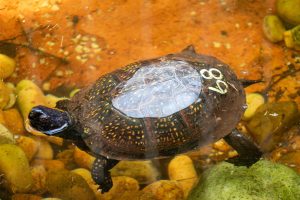
We provided a home for Gulf Coast box turtles at our Zoo after they were rescued by U.S. Fish and Wildlife Services as victims of wildlife trafficking.
Commonly trafficked animals are most often spider monkeys, capuchins, macaques and other primates, but can also include animals like parrots, cockatoos, turtles and tortoises, snakes and more. Just last December, we took in nine Gulf Coast box turtles who were bound inside socks in an attempt to smuggle them out of the U.S.
Now, we’ve become a permanent home for these turtles, as they cannot be released back into their natural range due to a unique disease they may have contracted during their trafficking.
Cases like these are precisely why our Zoo advises you to think twice before interacting with seemingly harmless, silly videos of wild animals housed as pets. This content, which often features animals living in human spaces like a house, wearing doll-like human clothes and performing human-like behaviors, only encourages the idea that wild animals make good pets.
Each like, comment, repost or share fuels the fire, encouraging the algorithm to spread harmful content farther and faster, regardless of the message being promoted. Sooner or later, we become desensitized to seeing wild animals in environments that do not suit their needs. We encourage you to abstain from interacting with dangerous content like this on your social media feeds and report any harmful activity you come across. On some social platforms, you can also click a “not interested” button, which removes content like this from your algorithm.
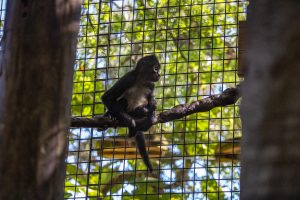
Finn and Marceline are wildlife trafficking victims who came into our care in 2024.
As an Association of Zoos and Aquariums-accredited zoo that is held to high standards of animal wellbeing, it’s rare for us to bring in animals from their native habitat — usually it’s because they require rehabilitation or come to us as victims of wildlife trafficking.
Our Zoo remains committed to raising awareness about the illegal pet trade, answering the call to help victims of wildlife trafficking and advancing field knowledge on how to ease confiscated victims into an AZA-accredited environment.
We’re proud to share that we have been recently accepted as a new member of the Association of Zoos and Aquariums’ Wildlife Confiscations Network, a collaborative effort between the U.S. Fish and Wildlife Service and AZA to ensure care and placement of wildlife confiscated from illegal trade. The Network supports law enforcement efforts against wildlife trafficking by providing a coordinated system to ensure the proper care and welfare of confiscated live wildlife.
Through this program, we will be able to respond to emergencies situations when USFWS needs to place confiscated victims into immediate care. Stay tuned to our blog and social media channels for more updates on how we answer the call.
Brevard Zoo is an independent, not-for-profit organization that receives no recurring government funding for our operating costs. Your generous support enables us to continue to serve our community and continue our vital animal wellness, education and conservation programs.