
Today, we’re celebrating International Day of Women and Girls in Science by sharing the experiences and insights from some of the amazing women in science at East Coast Zoological Foundation, the parent company of Brevard Zoo. Read on to learn more about how these women and girls are using their degrees to make a positive impact on the environment and animals around them. To read all of our features, visit this page.
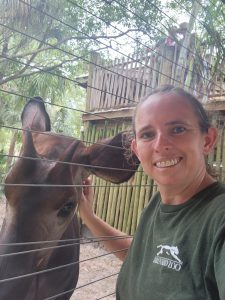
Let’s meet Cindy Watson, our Senior Africa Keeper.
What is your official title, and how long have you been at the Zoo?
I am a Senior Africa Keeper. I have been at Brevard zoo for 4 years but have been a zookeeper for 13 years.
What’s your educational background?
I have a bachelor’s degree in biology with an organismal concentration.
Why did you pursue your field?
I have always been fascinated with animal behavior and how animals have adapted to their changing environments over time to survive. I love to share my passion of animals and the conservation work that zoos do to help safeguard endangered species. The best way to help animals in their natural range is to spread awareness for those animals to other people so they can help in the fight to protect them. Being in this career allows me to not only work with animals, but also to educate the public on a daily basis.
What are some challenges about your work?
Working with animals and studying animal behavior can be physically and emotionally challenging. You want to do all you can to ensure that the animals have the best lives possible, but you always feel you can do more no matter how hard you work. Being an older female zookeeper, like me, you need to keep up physically with the younger keepers to ensure that you continue to pull your own weight. The hardest challenge I have faced, so far, in this field, is learning how to work with people in the younger generations. The expectations of keepers when I first started in this field are very different than they are now. The mindset, attitude and working priorities of the younger generation are different than they are in my generation, but I have learned to adapt to what the work culture has shifted to as the newer keepers trickle in and changes naturally occur.
What’s the most fulfilling part of your job?
The most fulfilling part of my job is seeing an animal’s quality of life improve because of something I did or something I had been working on. This could simply be a small change in a husbandry practice, or something bigger, like a breakthrough in a training session. We always strive to do what is best for the animals in our care. Part of that is creating an environment that promotes the animal’s ability to have choice and control over their own lives. My favorite part of my job is training animals to participate voluntarily in medical procedure and daily husbandry routines. When the animals know what to expect when a cue is given, the fear is minimized, and the animal is more willing to participate. The most fulfilling part of my job is seeing an animal make the connection between what we are asking and the behavior we want them to do. Being able to read animal behavior and make on the spot changes to set the animals up for success is key.
Who motivated you to pursue your field?
When I was a child in school, I wanted to be a veterinarian because animals had always fascinated me. After doing a few internships with veterinarians, I realized I loved the medical part of being a veterinarian but I did not like the lack of relationships the veterinarians had with their patients or that they only saw their patients when they were sick. My grandmother and sister suggested that I try to get into the zoo field. They suggested that I volunteer at our local zoo and see if I like the zoo environment. I started volunteering in my zoo’s commissary and giraffe feeding station. I immediately realized that the zoo field is where I was meant to be. I want to thank my sister and grandmother for pushing me towards this career. My animal behavior professor in college, Dr. Gunnels, also deserves credit for motivating me to pursue this field, because he taught me so much about animal behavior and how to read and interpret that behavior using the animals natural history and current environment.
What advice would you give to women or girls interested in pursuing a career in science? Start as early as you can to gain experience, knowledge, and skills. Volunteer work and internships are extremely valuable. Careers in the sciences are competitive, so do all you can early to set yourself apart from others. Work hard and do not be afraid to put yourself out there. Show confidence in your own skills and knowledge but be humble enough and willing to learn from others. Information and protocols in the field of science is constantly changing, so you need to be adaptable and willing to do the work to keep up with the times and the ever-changing information.