
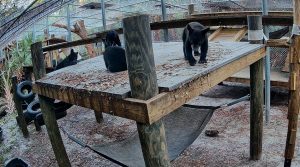
We’re currently caring for four juvenile Florida black bear cubs in our Black Bear Rehabilitation Center.
Editor’s Note: The Florida Fish and Wildlife Conservation Commission’s (FWC) Bear Management Program works closely with Brevard Zoo and other partners to ensure orphaned black bear cubs not yet able to survive on their own are given the best chances at successful rehabilitation and eventual release back into their natural habitat. The FWC aims to release rehabilitated young bears on public conservation areas that have high-quality bear habitat and low density of both bears and people to give them the best chances for survival.
We’re due for a cub-date on our four Florida black bear cubs, Scruffy, Sammy, Grape, and Palmer!
Since Florida Fish and Wildlife Conservation Commission’s Bear Management team rescued each of these orphaned cubs a few months ago, they have been living in East Coast Zoological Foundation’s Black Bear Rehabilitation Center at our Zoo. Arriving at just a few pounds each, the cubs have now grown anywhere from 30-50 pounds—a good indicator of strong, healthy development.
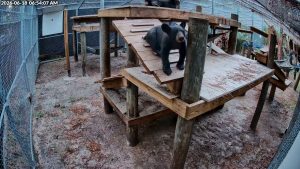
Sammy has grown from 6 to 48 pounds in just a few short months!
Sammy, the first cub patient of the year, is by far the largest in size and the most independent bear of the bunch, often venturing into the yard on his own to find food. Grape is the calmest of the crew.
Scruffy has developed an especially close bond with Grape, as Palmer has with Sammy, though all four of them love to spend time together! The cubs are most often seen roughhousing, chasing each other, climbing the structures inside the Rehabilitation Center, and eating—of course!
“It is amazing to see how they are not only growing in size but also in confidence, as well as seeing their personalities come through,” said Director of Animal Programs Lauren Hinson.
Whenever an orphaned cub joins our behind-the-scenes Center, our top priority is providing them with opportunities to “learn how to be a bear.” Because these cubs were stranded without a mother to show them behaviors like foraging for food, climbing, and socializing with other bears, it’s up to our team to teach them these survival skills—without allowing these cubs to think of people as any easy meal ticket.
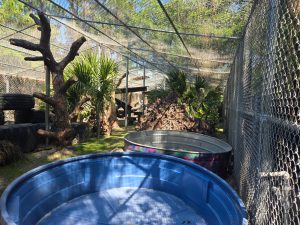
On top of keeper spaces and three indoor night houses, our Rehabilitation Center includes a 3,500-square-foot outdoor yard filled with plenty of climbing structures and enrichment opportunities.
In the early days of their rehabilitation at our Center, these little bears could find their food to find in obvious, easy-to-find places. But as the cubs grow more advanced in their foraging skills, their diet is now in more challenging places—hidden in wood shavings, in their pools, up in the trees of their habitat, and on their platforms.
Our Bear Rehabilitation team heavily relies on a camera system throughout the habitat for their behavior observations of the cubs. They enter the space wearing ghillie suits, a camouflaged clothing item, and typically coax the bears into a separate area when they service their habitat.
Our goal is to build their problem-solving skills by letting them search for their food as they would in their natural range. These critical behaviors will come in handy when we team up with FWC’s Bear Management team to eventually release all our rehabilitated cubs back to their native homes in wooded areas across the state. Bears play such an important role in their ecosystem as seed dispersers, so every cub saved is a win in preserving and protecting the Florida black bear species.
Stay tuned to our blog and social media channels for more updates!
Please contact the FWC’s 24-hour Wildlife Alert Hotline right away at 888-404-FWCC (3922) if you have found an orphaned, sick, injured or dead Florida black bear.