
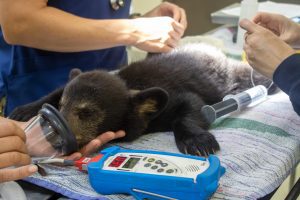
We are now up to four Florida black bear cub patients.
Editor’s Note: The Florida Fish and Wildlife Conservation Commission’s (FWC) Bear Management Program works closely with Brevard Zoo and other partners to ensure orphaned black bear cubs not yet able to survive on their own are given the best chances at successful rehabilitation and eventual release back into their natural habitat. The FWC aims to release rehabilitated young bears on public conservation areas that have high quality bear habitat and low density of both bears and people to give them the best chances for survival.
We have a new Florida black bear cub arrival to introduce — meet 3-month-old Palmer!
This female cub was spotted alone in the Central Florida area. Bear cubs at this age have very little chance of survival in the absence of their mother as they rely on her for food, navigation and guidance.
Palmer was rescued from a palm tree (hence her fitting name) by FWC Bear Management staff, with the help of the Orange City Fire Department. From there, FWC transported the baby bear to our L3 Harris Animal Care Center for a full veterinary checkup.
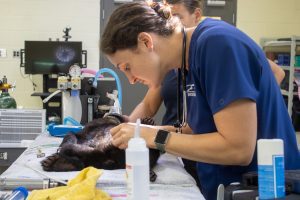
Director of Veterinary Programs Dr. Rachel Turner examines Palmer
Upon her intake exam, our vet staff deemed the cub generally healthy, with just a few ticks. We provided treatment to rid of any fleas and ticks, gave her a dewormer and administered IV fluids to rehydrate the cub. Unlike our first three cub patients, Scruffy, Sammy and Grape, Palmer has a bit more weight on her at 9 pounds.
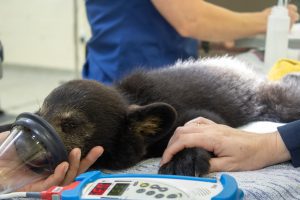
Palmer can be identified by her blonde coloring around her muzzle and eyes — though Florida black bears tend to lose some of this coloring as they age.
Since releasing 17 former cub patients back to their natural range, East Coast Zoological Foundation’s Black Bear Rehabilitation Center has been especially quiet. Over the last few months, our bear care team took full advantage of the empty Center to reset the entire space ahead of this year’s cubs — including cleaning up leftover messes, restocking the area and adding new trees, plants, grass, feeders, platforms, shade and a second pool.
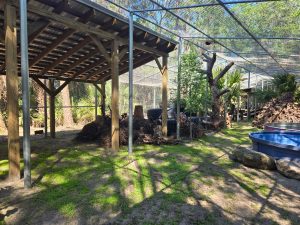
Our Black Bear Rehabilitation Center received a full refresh ahead of welcoming this year’s cubs.
Soon after Scruffy, Sammy and Grape made their debut in the Rehab Center, Palmer was medically cleared to join the crew. As a curious and playful bear, Palmer made friends with the others straight away and became especially bonded with Sammy.
As cub patients trickle in, they will slowly be cleared and added to the Rehabilitation Center, where they will spend their days growing, socializing, playing and learning important “bear behaviors” like foraging for food. Once all the cubs are ready to take on the world with their newfound survival skills, we will work with the FWC’s Bear Management Program to release them back to their natural habitats.
Keep up with our blog and social media channels for updates on our growing pool of bear cub patients!
Please contact the FWC’s 24-hour Wildlife Alert Hotline right away at 888-404-FWCC (3922) if you have found an orphaned, sick, injured or dead Florida black bear.