

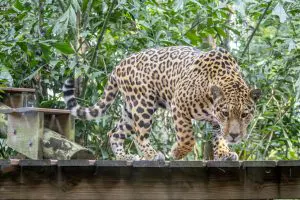
Khan the jaguar explores his habitat.
Editor’s note: We are reflecting on our 12 most impactful moments of 2025. Your support made these incredible stories of rescue, recovery and wonder at your Zoo possible. Thank you. We celebrate what your support made possible – and ask you to help create even more magical moments in 2026. Thanks to our generous matching donors, the first $30,000 in donations will be matched dollar for dollar, making these gifts even more joyous. Learn more here.
As we look back on 2025, we’d be remiss not to mention a few of our new animal residents, including our jaguars, Lua and Khan, and our Masai giraffe, Aurora.
These animals joined our Zoo family as part of what is known as the Association of Zoos and Aquariums (AZA) Species Survival Plan (SSP). The SSP program was designed to pair animals across AZA-accredited organizations together to ensure a genetically diverse population of species. The program is especially important for animals whose populations are dwindling in their native ranges; By building a healthy population of threatened or endangered species in AZA-accredited zoos like us, we can support the long-term vitality of numerous animals.
In April, we welcomed Aurora, a now 2-year-old Masai giraffe, from the Phoenix Zoo. Traveling over 2,000 miles in a specially designed carrier, Aurora made it a long way to get here! Her move was a part of the AZA Species Survival Plan for Masai giraffes, as the species is considered endangered in their natural range.
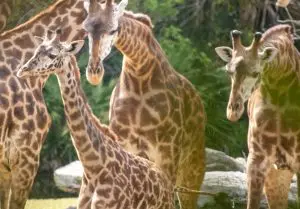
Aurora walks alongside our giraffe herd in our veldt.
Because many of our giraffes were and are older in age, it’s been quite some time since a calf has been born at our Zoo. However, between Aurora and our two other female giraffes, Tisa and Kumi, we hope to welcome a calf in the coming years.
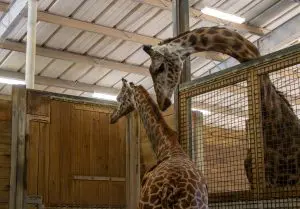
Our beloved and late female giraffe, Milenna, was instrumental in introducing Aurora to the rest of the herd.
Over in our Rainforest Revealed loop, we also welcomed two new jaguars: Khan and Lua! For a good while, 21-year-old Masaya was our sole jaguar at our Zoo. During her lifespan, she’s given birth to six jaguars, who reside in other AZA-accredited zoos across the country. Fun fact: Masaya is actually a great grandmother now! Little Rojo was born at the Houston Zoo last year.

At almost 22 years old, Masaya is well past the median life expectancy for jaguars.
Given her older age, Masaya’s birthing years are behind her. As we continue to give Masaya the best care during her golden years, we wanted to continue our work to support the threatened jaguar population.
Lua was the first to join our Rainforest Revealed crew, traveling all the way from the Zoo de Granby in Canada to ours in May as part of the Species Survival Plan for jaguars. The 6-year-old jaguar is known among our keepers to be curious in nature and eager to learn new training behaviors.
Lua has a lighter, cream-colored coat.
Once we knew Lua was well adjusted to her new home, it was time to welcome Khan the 12-year-old jaguar from the Birmingham Zoo! Khan and Lua resided in separate habitats for a couple of months before we started any introductions to ensure both animals felt comfortable in their own spaces.
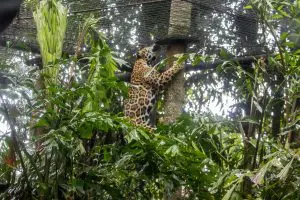
As you can tell, Khan made himself right at home!
Eventually, we began a thorough introduction process broken down into several stages. We began with a “full howdy,” meaning Khan and Lua took turns living in one of our habitats; This let each jaguar familiarize themselves with the other’s scent and prepared them for the next step. We then began allowing the cats to see and smell each other through the mesh. Finally, we introduced the two in the same habitat, slowly building up the increments of time the two spent together.
As we expected, there was a bit of tension during the initial introductions, but Khan was very submissive toward Lua, letting her have her space when she needed it. Today, Lua and Khan live peacefully together in the same habitat.

Lua (left) watches Khan (right).
We are proud to support the populations of these special species at our Zoo. Here’s to hoping for babies in 2026!
We would like to thank the following generous donors for supporting our mission-based programs:
Flammio Financial Group · Stifel- Garvin Wealth Management Group · Artemis IT · Pepsi Bottling Company · Amazon · PCL Construction | Nassal | MEC | Heard