
Editor’s note: We are reflecting on our 12 most impactful moments of 2025. Your support made these incredible stories of rescue, recovery and wonder at your Zoo possible. Thank you. We celebrate what your support made possible – and ask you to help create even more magical moments in 2026. Learn more here.
This Giving Tuesday, we are highlighting our important work with black-handed spider monkeys. Our spider monkey habitat opened in 2020 and later that year our Zoo became a place where rescued spider monkeys can get a second chance at life.
Wildlife trafficking is a critical issue facing spider monkeys and many other primate species. This illegal practice removes baby monkeys from their native homes and families, often as part of the pet trade. However, we work to the best of our abilities to provide our rescued spider monkeys with opportunities to find their place amongst our troop.
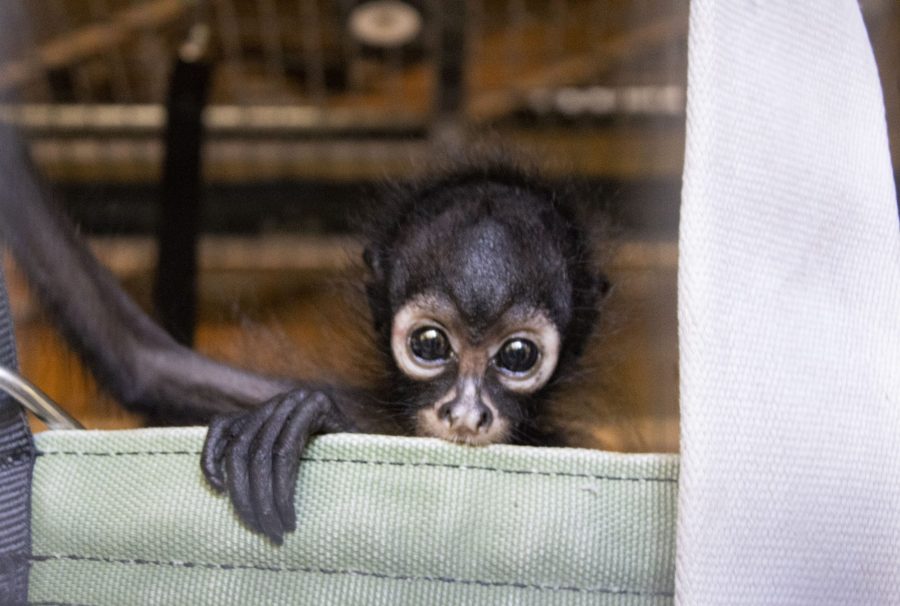
Our Zoo has extensive experience caring for confiscated spider monkey infants. These young monkeys often come to us unsure of themselves and our other troop members. However, our skilled staff are experts at acclimating these impressionable infants.
“It’s been an incredible experience caring for confiscated spider monkey infants.” said Curator of Animals Sidnee. “It’s rewarding to know that they will have opportunities to experience a more natural social structure and life here at our Zoo than what they would have had in their previous situations.”
This year, we welcomed two new infants, Fernando and Honey. We hope to introduce them to the rest of the troop soon. Our team is waiting for the pair to get a bit bigger and show specific behavioral cues signaling they want to interact with the rest of the troop.
Our special habitat setup allows us to continue taking in confiscated monkeys and growing our troop. We have three large habitats, a cognition center and two night houses all connected by sky pathways. This ample space allows the monkeys to break off into groups, just like they would do in their native range. This space also allows us to slowly introduce new monkeys to our existing troop, ensuring that we can go at the pace of each unique individual.
“We have watched them learn how to reconcile with each other on their own terms because they’ve taken time apart to cool down,” said Sidnee. “The best is watching new monkeys gain confidence, learn new skills and become independent.”
This year, we also saw changes with some of our longtime troop members. Our alpha male, Shooter, has begun to hand over much of his responsibility to our younger male, Mateo. Mateo was once a shy monkey that came to us after being rescued from the illegal pet trade, but he has grown into a confident leader. The job of the alpha male is to enforce rules and make sure aggression does not get out of control. Shooter now only steps in occasionally to assist or correct Mateo’s behavior.
It is common for these transfers of power to be marked by aggression as the males vie for power, but it seems Shooter was happy to retire and promote Mateo as the new leader of the group. Mateo even became a father this year, a key indicator of his new status!
Our troop’s unique social dynamics are closely observed by our partners at the Florida Institute of Technology. Through our collaboration, dozens of students have gotten the opportunity to monitor and learn from our troop, assist in research and help us navigate introductions with young confiscated infants.
Over this decade-long partnership, Dr. Darby Proctor, Dr. Catherine Talbot and their students have collected observational data on our monkeys, allowing them to gain a better understanding of this species’ social dynamics.
This year, the university’s team has begun working with the monkeys to voluntarily enter our cognition center, a place where hands-on research can take place. They’re currently developing a touchscreen computer that will be used to explore our monkey’s cognition. Currently, they are using a prototype, and we hope to be able to show more of this process soon!
As we wrap up this year, we are incredibly grateful for the milestones that your support has allowed us to achieve when it comes to helping this species. Whether we’re introducing another orphaned spider monkey infant to our troop or facilitating ground-breaking research, our Zoo is always ready to answer the call to foster the wellbeing of this species at our campus and beyond.
Brevard Zoo is an independent, not-for-profit organization that receives no recurring government funding for our operating costs. Your generous support enables us to continue to serve our community and continue our vital animal wellness, education and conservation programs.
We would like to thank the following generous donors for supporting our mission-based programs:
Flammio Financial Group · Stifel- Garvin Wealth Management Group · Artemis IT · Pepsi Bottling Company · Amazon · PCL Construction | Nassal | MEC | Heard