
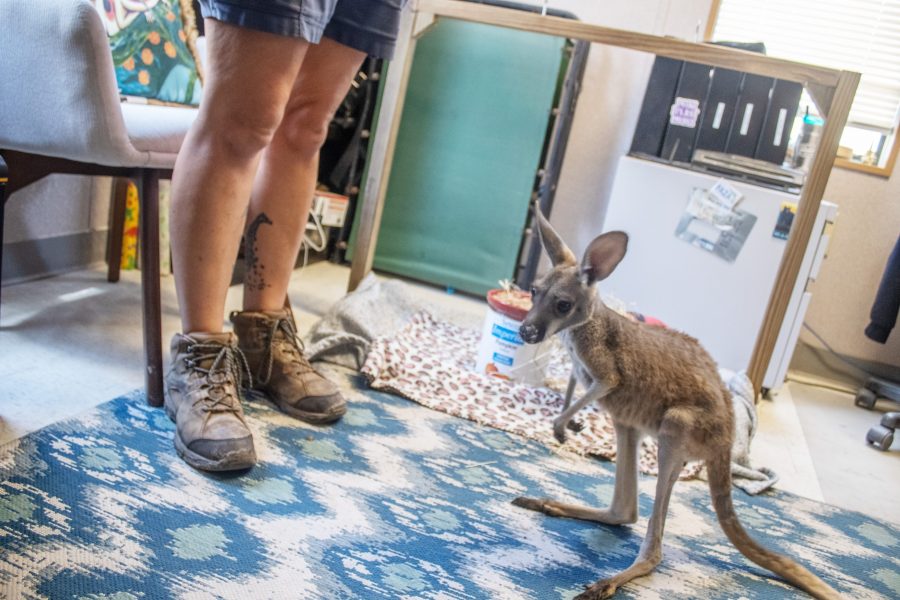
One of our newest members of our red kangaroo mob is receiving some intensive care from our animal care and veterinary teams after sustaining a significant injury to one of her legs.
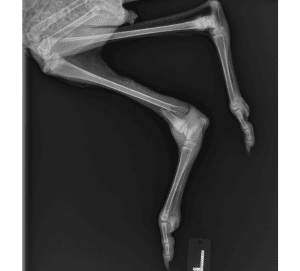
An x-ray image of Holly the red kangaroo’s fractured leg.
In late June, our animal care team discovered that 6-month-old Holly the kangaroo joey had an injured leg. She was immediately taken to our L3 Harris Animal Care Center for an exam, and we learned that she had broken her left hindlimb.
We’re not sure how Holly sustained this injury, but it’s not unheard of. Joeys have fragile bones, especially when they first begin hopping in and out of their mothers’ pouches – and joeys aren’t always the most careful with keeping their legs (and other body parts) inside the pouch when their mother moves around.
“In the wild this would have been an injury that would have gone unnoticed until it was too late, but the close attention that our keeper staff pays to all of the residents here allowed us to catch the issue early enough with time to intervene,” said Dr. Garrett Crooks, staff veterinarian with Brevard Zoo.
Considering Holly’s age and the significance of this injury, we opted to consult with an outside medical partner, Dr. Jeffrey Christiansen of Animal Specialty & Emergency Hospital, to repair her leg. Dr. Christiansen has partnered with us on several other cases over the years, including surgery to correct hip dysplasia for our male resident Florida black bear, Brody.
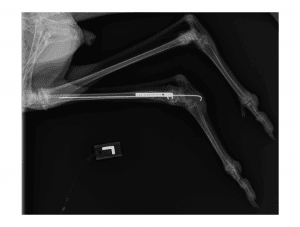
An x-ray image of Holly the red kangaroo’s fractured leg.
“Close collaboration with specialist consultants allows us to provide an even greater level of care for our residents, as this was a very complicated fracture and repair,” Dr. Crooks said. “Dr. Christiansen and his team have been incredibly helpful over the years with a number of cases that certainly benefited from their specialized expertise.”
Dr. Christiansen used supportive hardware – a combination of a plate, screws, and a pin – to bring the break in Holly’s leg back together and stabilize it to allow the bone time to repair. This hardware remained in place for a few weeks until we saw an appropriate amount of healing take place in the leg. The leg still has necessary support while it heals, while giving her the chance to use the leg more naturally – hopefully helping her continue to develop normal ankle functionality.
Holly then went through the next step in her healing journey: the removal of the pin preventing her from being able to flex that ankle joint while her bones healed. She also received stem-cell treatment thanks to banked stem cells from a former Zoo animal resident to improve her chances of healing well. This stem cell service is in partnership with Vet Stem.
While under normal circumstances the plate and screws could be left in long-term, the location of the fracture made it necessary to have a couple of her screws very close to her growth plate, which could affect the development of her leg. Our care teams are continuing to monitor her closely and are performing regular radiographs of her leg to see if any more hardware will need to be removed.
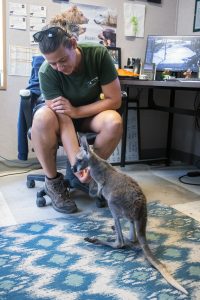 While she continues to recover, Holly is being cared for by our Director of Animal Programs Lauren Hinson, who has experience caring for joeys. Holly spends much of her time tucked in a fabric pouch – but raising a joey is no small feat!
For over a month, she was fed every four hours, and although one of her feedings has been dropped, the last one is still at midnight. For the first month, Holly was not allowed to leave the pouch on her own as she recovered, but she’s now graduated to controlled activity after she eats. She can leave the pouch and get her legs stronger as she hops around.
The formula itself is complex as we try to mimic the milk a kangaroo mom produces, which changes naturally as the joey grows. Kangaroo milk will fluctuate in the level of carbohydrates and fats, and that has to be replicated synthetically by adjusting the formula at key points in their lives, Lauren said. Holly has now transferred to the last stage of milk. Their milk is very concentrated as well, so joeys have to be supplemented with water to maintain hydration.
Once she’s fully recovered, she will start introductions with our Kangaroo Walkabout habitat and the rest of the mob. This looks like hanging out in her pouch in this space’s nighthouse and gradually meeting Walkabout residents.
It may sound surprising, but Holly and her mom, Hope, will not have any special introductions. Kangaroo moms are often quick to reproduce – and Hope already has a weeks-old joey in her pouch.
We’re hopeful that with the expert care from our animal and veterinary teams, Holly will continue making strides in her healing and eventually be a full member of our kangaroo mob. We’ll share any more updates on her here or on our social media channels!