
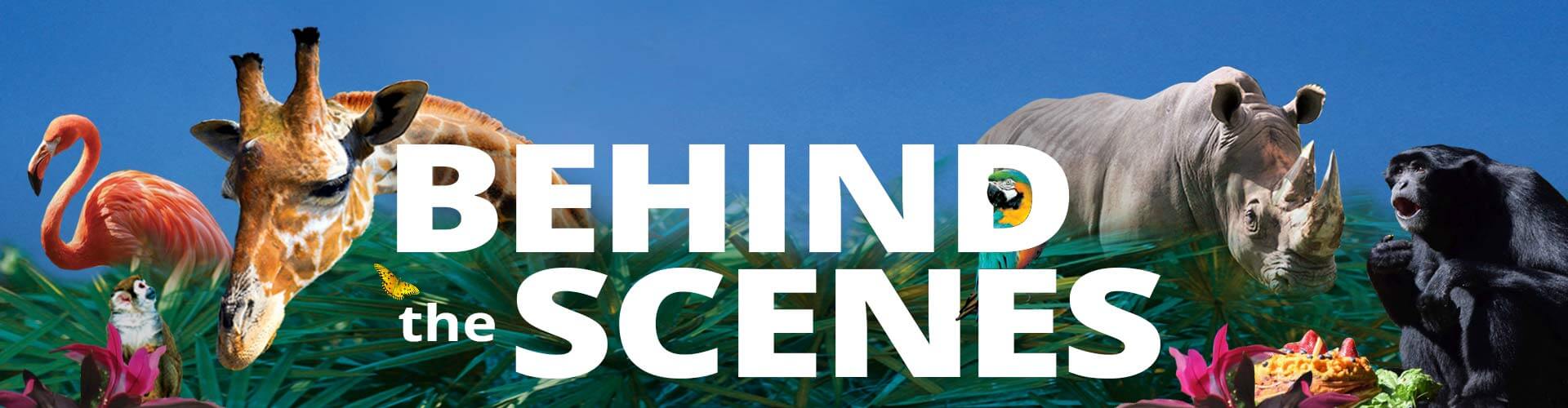
Gollum receives his routine veterinary exam at our L3 Harris Animal Care Center
At our Zoo, animal wellbeing is a top priority — whether it’s creating thoughtful enrichment, providing our animals with choice and control or delivering expert veterinary care. One of the many ways we stay on top of our animals’ health is through routine veterinary examinations. These checkups help us tremendously as they establish a baseline for our residents’ health and give us insight into any underlying conditions that may be present.
While many of our exams follow a simple process for our smaller animal residents, a checkup for 511-pound Gollum the American crocodile looks a bit different to say the least.
In the years leading up to Gollum’s exam, our Herps & Aquatics animal care team worked diligently to train the crocodile to voluntarily participate in his own healthcare. The first part of this process is what’s known as “target training,” in which Gollum received positive reinforcement (a.k.a. food) whenever he followed a “target,” or a painted stick, into an airlocked space near his habitat.
Gollum is also injection-trained to sit still and accept a needle probing his front leg — a key component of voluntary sedation. This enabled us to not only insert the actual needle successfully, but it also helped Gollum remain calm, increasing the likelihood that his sedation medication takes effect (reptiles, especially crocodilians, can be extra tricky to sedate), said Curator of Animals Nicole Payne.
Finally, he was trained to walk into a “body rope” atop a large blue tarp and accept another rope being wrapped and tightened around his jaws. This step in his training was crucial as we replicated the process during his actual exam. Plus, added tools like ropes ensure the safety of both Gollum and our teams in the event that his anesthesia did not fully take effect.
This developed behavior, built on trust between 40-year-old Gollum and his keepers, is one of the several ways we exercise choice and control here at our Zoo — if at any point Gollum declines to participate in his training sessions, he is always free to walk away.
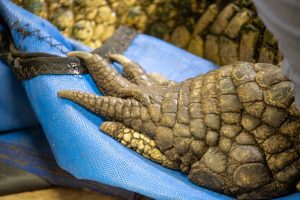
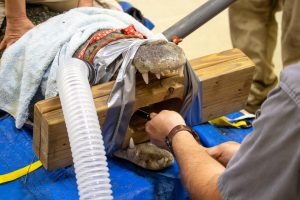
Gollum is one of our two American crocodiles, along with his habitat-mate, Lilly.
And the training paid off! The day of his examination, we successfully sedated Gollum to safely transport him to our L3 Harris Animal Care Center. At the hospital, Gollum received a full exam including a physical examination, bloodwork, X-rays and an ultrasound.
Last but not least was a gastrointestinal endoscopy to examine the inside of the crocodile’s stomach. After propping open his jaws, our team suctioned the liquid from his stomach and inserted a tube with a camera attached down through his esophagus to stomach. There, we discovered tiny pieces of wood and sadly, numerous pieces of plastic, likely from trash making its way into Gollum’s habitat — whether deliberately or accidentally.
Because Gollum’s stomach is over 5 feet from his mouth, we learned that pulling out items from his stomach would be trickier compared to many of our other, smaller animal residents. We now plan to gather the tools to soon repeat the exam and extract these items from Gollum’s stomach.
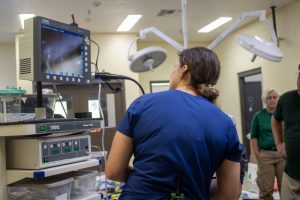
Dr. Rachel Turner examines the items inside Gollum’s stomach during his endoscopy.
In the meantime, we’d like to take a moment to remind our readers how important it is to properly dispose of our trash. Bits of trash can commonly look like food items, tricking an animal into ingesting harmful plastic pieces and leading to lifelong or life-threatening issues.
It’s up to us to be a friend to wildlife, no matter where you are.
We would like to thank the following generous donors for supporting our mission-based programs:
Flammio Financial Group · Stifel- Garvin Wealth Management Group · Artemis IT · Pepsi Bottling Company · Amazon · PCL Construction | Nassal | MEC | Heard