
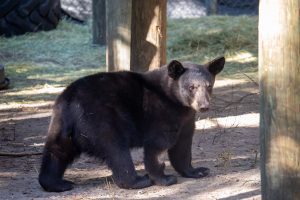
Our Zoo has become a hub for Florida black bear cub rehabilitation.
Editor’s note: We are reflecting on our 12 most impactful moments of 2025. Your support made these incredible stories of rescue, recovery and wonder at your Zoo possible. Thank you. We celebrate what your support made possible – and ask you to help create even more magical moments in 2026. Thanks to our generous matching donors, the first $30,000 in donations will be matched dollar for dollar, making these gifts even more joyous. Learn more here.
As East Coast Zoological Foundation (ECZF) grows, so do our conservation efforts. This past May, we opened our first space designed specifically for the rehabilitation of Florida black bear cubs. Nonprofit ECZF leads the Brevard Zoo and upcoming Bowen Aquarium campuses, working to conserve Florida species like our local black bears.
Thanks to our Black Bear Rehabilitation Center at our Zoo, affectionately known as Brody Bear’s Rescue and Rehab, we’re able to expand our impact even further. Since orphaned and sick bear cubs cannot survive without their mothers’ guidance to learn critical bear skills like foraging, socializing and climbing, it was up to us to step up to the plate.
Our state-wide conservation initiative to help this species began in 2023 when our Zoo opened its doors to medically rehabilitate, house and release orphaned, sick or injured cubs found by the Florida Fish and Wildlife Conservation Commission (FWC). Since then, our vision to rescue cubs across Florida has only grown.
Together, Director of Animal Programs Lauren Hinson and Bear and Wellbeing Coordinator Marc Franzen, dreamed up a secluded, behind-the-scenes space that would allow cubs to flourish in an environment that mimics their natural habitat. The Rehabilitation Center was made possible by the generous donations of Pat McMahon and Bob Mansbart.
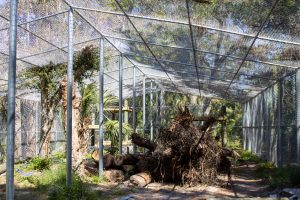
Our Black Bear Rehabilitation Center has a 3,500-square-foot outdoor yard and three indoor nighthouses to house cubs until their release.
With the opening of our Rehabilitation Center, we have been able to take in more cubs than ever—17 this year, to be exact!
“Not only have we been able to care for more bear cubs in the new Center, but we have also been able to provide them with a naturalistic experience where they can play, swim, climb and do all the activities that bear cubs do out in their natural range in Florida,” said Lauren.
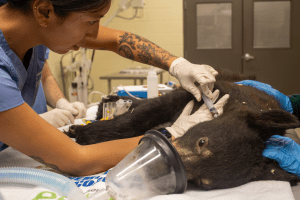
Each time FWC brings a new cub to our L3 Harris Animal Care Center, we perform a full veterinary exam, including a physical check, weight checks, X-rays, bloodwork and more. Once our vet team has determined a cub is in a sufficiently healthy condition, the little one is transferred to our Rehabilitation Center.
Inside the Center are structures our bear team designed specifically for bringing out those important bear skills like climbing and exploring. Lauren and Marc also routinely scrub through hours of camera footage to see which enrichment items elicit desired cub behaviors we aim to teach like foraging. From there, we’re able to tweak how we provide for these growing cubs.
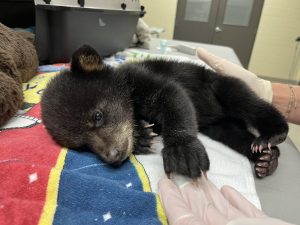
One of our bear cub patients, Rickie, during her intake exam.
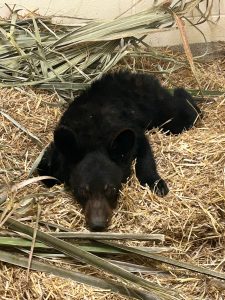
One of our most transformative cases was Jon Bear’s. Though we’re unsure of the yearling cub’s past, he arrived at our Zoo on the brink of death. Fortunately, Jon Bear was able to make a full recovery after several months of medication, food and veterinary care.
Jon Bear tripled his weight and is feeling much better after just a few short months under our care!
Bear cubs are typically born early in the year during bears’ hibernations, so many of the cubs who come through our doors are around the same age. But that’s not always the case.
This year, we took in two yearling cubs (meaning they’re aged around a year or older), Jerry Donuts and Jordan. Older, more mature cubs require different needs and don’t always play nicely with younger cubs, so in Jerry Donuts’ and Jordan’s best interest, they were released earlier this year.
Jerry Donuts was actually our Black Bear Rehabilitation Center’s very first patient!
As for the remaining 15 cubs, they will live together in our Black Bear Rehabilitation Center until their slated release back to their natural habitats in January 2026. Working with the FWC’s Bear Management Program, we plan to release these cubs in areas which are sparsely populated with humans and other bears, giving these cubs the best chance of thriving in their natural range once again.
We’re grateful to be one of the only resources to rescue, rehabilitate and release Florida black bear cubs in the state, and we can’t wait to continue this important conservation work in 2026!
Wondering what to do if you ever spot what looks like an injured, sick or orphaned cub? Please report it to the FWC’s 24-hour Wildlife Alert Hotline at 888-404-FWCC (3922) so that trained staff can respond. FWC bear biologists will attempt to rescue cubs found on their own that aren’t old enough yet to be self-sufficient. Black bear cubs are typically born in January or February in Florida, and cubs found orphaned before August 1 (and/or that are under 30 pounds) would not be able to survive on their own. The FWC’s Bear Management Program also asks people to report sightings of any injured, sick or dead bear to the Wildlife Alert Hotline so that staff can respond.
We would like to thank the following generous donors for supporting our mission-based programs:
Flammio Financial Group · Stifel- Garvin Wealth Management Group · Artemis IT · Pepsi Bottling Company · Amazon · PCL Construction | Nassal | MEC | Heard