
Editor’s Note: We’ve become a permanent home for these turtles, as they cannot be released back into their natural range due to a unique disease they may have contracted during their trafficking.
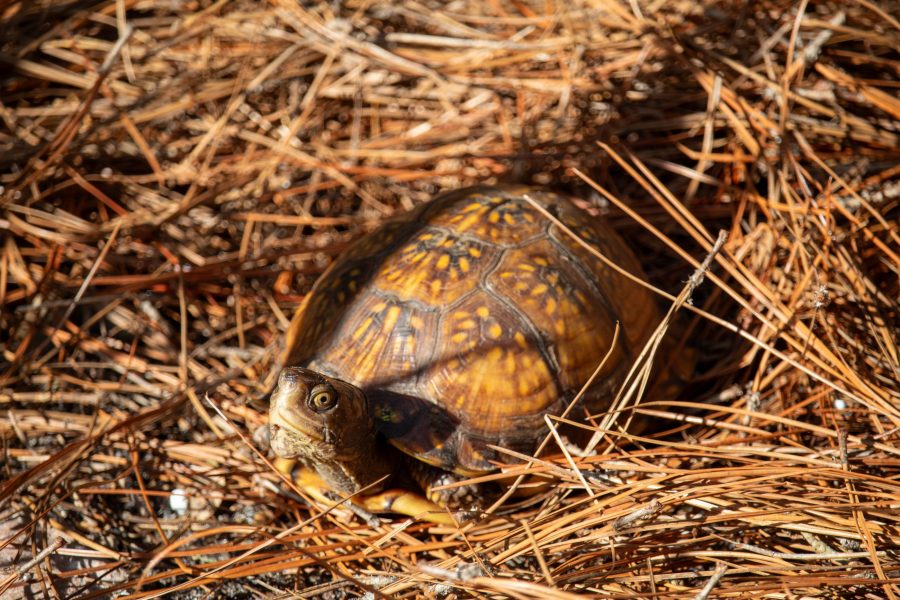
Nine Gulf Coast box turtles have found a safe home at our Zoo after being rescued by U.S. Fish and Wildlife Services (USFWS) from wildlife trafficking.
These turtles were just a fraction of the number of animals rescued. In August, Wei Qiang Lin of New York pleaded guilty in U.S. District Court for the Western District of New York for falsely labeling live turtles as “plastic animal toys” before exporting them in delivery boxes on a weeks-long journey to Hong Kong, according to USFWS. Lin is scheduled to be sentenced on Dec. 23.
While we don’t know the conditions in which the turtles were kept in before Lin tried to smuggle them out of the country, we know that they were found bound and taped inside knotted socks within shipping boxes.
These nine box turtles – just a fraction of the number of animals Lin was trying to smuggle out of the country – were brought to Roger Williams Park Zoo in Rhode Island for care before moving to our Zoo this December.
 The group is now in good health and living their best lives in an outdoor habitat with another group of their species in our Wild Florida area. The turtles will stay with us with the goal to eventually release them back to their native range, as directed by state and federal authorities.
Wildlife trafficking is one of the largest illegal trades, after drug and human trafficking, and is estimated to be worth between $7-23 billion per year. Zoos accredited by the Association of Zoos and Aquariums (AZA) – like our Zoo and Roger Williams Park Zoo – are always ready to do their part in helping animals in need. This issue continues to increase in scope and severity.
Wildlife trafficking is a crisis in a number of ways, from animal wellbeing to biodiversity. As we see in this case, victims of wildlife trafficking are often subjected to horrific conditions during transport. We’re thankful these nine survived their initial journey – this is rare in trafficking. The few surviving animals are then sold to people who often don’t know how to meet their basic needs.
Found in Florida’s panhandle, Gulf Coast box turtles have several roles in their ecosystem like spreading seeds, controlling populations of some of their favorite snacks like insects and other invertebrates, and more.
By removing box turtles and other creatures from their native habitat, trafficking pushes these species toward extinction. This disrupts the ecosystems you live in and benefit from. By preserving biodiversity, we protect our earth for our community and those to come.
You can help defend species from wildlife trafficking by:
This new habitat was made possible in part by The Margaret Heins Foundation.
We would like to thank the following generous donors for supporting our mission-based programs:
Flammio Financial Group · Stifel- Garvin Wealth Management Group · Artemis IT · Pepsi Bottling Company · Amazon · PCL Construction | Nassal | MEC | Heard