
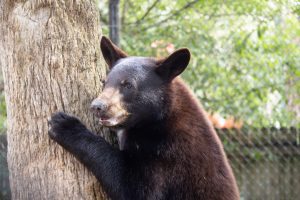
Rickie, one of our former Florida black bear rehabilitation patients, is back at our Zoo as a permanent resident.
Rickie the Florida black bear cub has returned to our Zoo—and this time, she’s here to stay.
Last April, the orphaned six-week-old cub was found wandering the Florida panhandle with nowhere to turn. Since young cubs cannot survive without their mother’s guidance, we knew this little one desperately needed our help. In no time, Florida Fish and Wildlife Conservation Commission’s (FWC) Bear Management team swiftly transported Rickie to our Zoo’s L3 Harris Animal Care Center where she received a full veterinary checkup.
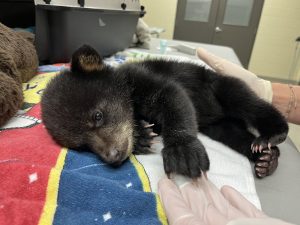
We first met Rickie in April of 2025.
Ordinarily, each of our cub patients spends a limited time here before joining the rest of our growing cub crew in East Coast Zoological Foundation’s Black Bear Rehabilitation Center at Brevard Zoo and eventually being released back to his or her natural range. But Rickie’s case was different.
Rickie was the smallest and one of the youngest cubs we’ve ever cared for, weighing a mere 2.5 pounds. At this age, cubs like Rickie require around-the-clock bottle feeding to steadily increase their weight. The tricky part is delivering this care without the cubs imprinting on us. The more comfortable cubs are with humans, the greater the chance they will carry this behavior into adulthood, which would prevent them from being released back to their native habitat.
Our bear wellbeing team took every possible measure to prevent this from happening— like disguising themselves in masks and ghillie suits, not speaking aloud, and keeping a loud fan blaring in the background to reduce the sounds of their actions and footsteps while delivering food. Each step was meticulously planned so that Rickie would hold onto her natural fear of humans and not connect people with food.
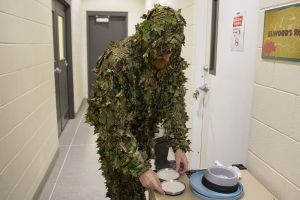
Animal Wellbeing and Bear Coordinator Marc Franzen disguises himself with a ghillie suit before delivering food
“The way we cleaned, the way we fed, the way we interacted was different,” said Director of Animal Programs Lauren Hinson. “If she told us she was becoming too interested, we changed something.”
Finally, Rickie gained enough weight to be transferred to our Rehabilitation Center along with our other cub patients, where she spent the next ten months learning key bear behaviors like foraging, climbing, socializing and more. Before we knew it, January arrived, and the cubs were ready to be released back to their natural range in forested areas around Florida that are sparsely populated with both humans and other bears.
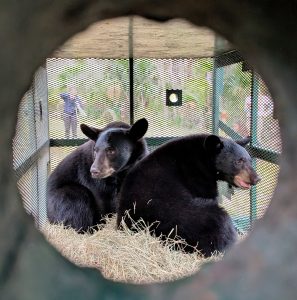
Rickie (right) before her release in January
When it came time to release the group of cubs, Rickie showed the same behaviors of independence and wariness of humans that the other cubs showed — both key aspects needed for any released bear cub in order for them to thrive on their own. However, since Rickie’s case was unique, having been so small and young at the time of her initial rescue and having needed that more in-depth care, we worked with the FWC’s Bear Management team on a contingency plan in case she needed assistance after her release. The decision was made to release Rickie with the other cubs, giving her the opportunity to live on her own in her natural range, but a plan was in place if she again needed our help. During the months following her release, it was later found that Rickie was offered human food by members of the public, conditioning her to be overly friendly toward people and unfortunately likely erasing the months of hard work to keep her from associating people with food. In a decision to prevent any possible human-bear conflict and keep both Rickie and members of the public safe, FWC Bear Management staff brought the yearling bear back to the Zoo to become a permanent member of our Florida black bear family.
Fortunately, this is a very rare occurrence. Of the 17 bears we rehabilitated and released, Rickie is the only one that had to come back into our care.
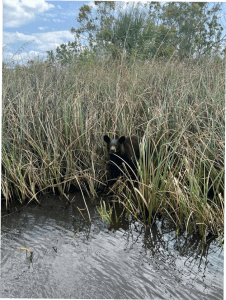
Rickie after being found again by FWC
While we are thankful we can step up and provide Rickie with a forever home, we wish she could have lived out her life in her natural range.
We understand it may be tempting to interact with wildlife, but feeding bears is illegal for a reason. By food-conditioning bears in their natural habitats, we only increase the chances of conflict that potentially put both their lives and ours in danger.
“We want people to enjoy seeing bears,” said FWC Bear Management Coordinator Mike Orlando. “When you see a bear, I want you to have that experience of, ‘This is amazing!’— but don’t push it any further, don’t approach the bear, and never feed bears. It always leads to a negative outcome, and the bear usually suffers in the end.”
Ultimately, being “BearWise®” is our end goal—and we know it’s possible. When we respect bears’ space, they respect ours, and we can both thrive alongside each other peacefully. You can visit FWC’s website for more tips on how to coexist with bears.
Currently, Rickie is slowly being introduced to our other resident bears, Brody, Betty and Cheyenne, in their Wild Florida habitat. We’re aiming to learn more about Rickie’s needs since being in her natural range, so that we can adjust her care accordingly. Eventually, we hope to begin work on an expansion of this resident bear space in the near future as well.
Stay tuned to our blog and social media channels for more updates on Rickie as she settles into her new home!
Contact FWC’s Wildlife Alert Hotline at 888-404-FWCC (3922) if you have found a sick, orphaned, injured or dead Florida black bear.
Special thank you to Pat McMahon and Bob Mansbart for their contributions toward our Black Bear Rehabilitation Center, affectionately known as Brody Bear’s Rescue and Rehab.