
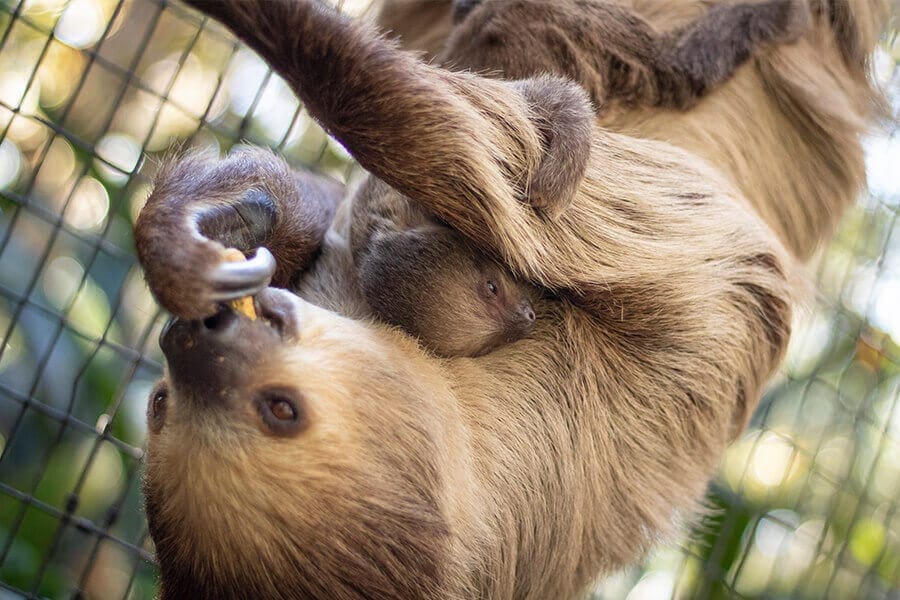
This 2019 photo is of Sammy the two-toed sloth with one of her infants.
It has been a difficult few weeks at our Zoo as we are heartbroken to share the passing of two of our Linne’s two toed sloths, 23-year-old Dustin and 20-year-old Sammy.
Dustin and Sammy appear to have been dealing with health issues that are being reported with increasing frequency in sloths under human care in in many zoological facilities. Our veterinary team is still waiting for more information from histopathology, or the microscopic examination of the cells of organs, before making any final conclusions.
Sloths have a delicate and very complex gastrointestinal system, said Dr. Rachel Turner, our Zoo’s Director of Veterinary Programs. Zoological medicine is a collaborative field. As a veterinarian at an organization accredited by the Association of Zoos and Aquariums (AZA), and a diplomat of the American College of Zoo Medicine, Rachel has resources and contacts in the zoological medical field, where there have been ongoing discussions regarding issues for sloths under human care.
Organizations are dealing with sloths experiencing nutritional issues, metastatic mineralization (essentially, a vitamin and mineral imbalance) and premature deaths, Rachel said, adding that this is occurring in sloths that originally come from the pet trade and from those who are born at AZA-accredited zoos. Sloth diets in their native habitat may be difficult to replicate, leading to these imbalances. This issue is still being explored.
“We still don’t have a lot of good answers for why it’s happening, even in animals receiving excellent care,” Rachel said.
 Dustin came to our Zoo in 2006 after living as someone’s pet. We don’t know what his life or nutrition was like during this time, but Dustin has since had long-term issues with a poor hair coat, abnormal nails and thin body condition. Our veterinary team had been closely monitoring Dustin over the last few months after a CT scan during routine exam found signs of the metastatic mineralization on multiple organ systems. An imbalance of calcium, phosphorous and vitamin D can lead to these mineral deposits, which often results in poor nutrient absorption, decreased kidney function, arthritis and other health issues. These deposits cannot be removed once they’ve formed. Dustin had started showing signs of experiencing some of the severe symptoms of metastatic mineralization, and our team made the difficult and compassionate decision to euthanize him to prevent future suffering.
Sammy, Dustin’s partner for many years, also showed signs of mineralization on a CT scan during a routine exam this year. Unlike Dustin, however, she had normal bloodwork and the other results of her exam were normal. She recently started having soft feces, and she was checked for parasites and treated with probiotics and medication. Despite her appetite and energy levels being normal, she was unexpectedly found deceased in her habitat. A necropsy found a kidney stone, but it didn’t appear to be causing further issues like a full urinary obstruction or infection. As we noted above, histopathology may help us gain more answers.
Both Dustin and Sammy were well beyond their species’ median lifespan, which for males is 20.7 years and for females is 13.6 years, according to the Association of Zoos and Aquariums (AZA).
Even though Dustin and Sammy lived long lives with us, we know how difficult it is to lose more members of our animal residents in a relatively short amount of time. We know how much our animal residents mean to you, especially two long-time residents like Dustin and Sammy. It’s important to us to be transparent with you by giving you a look at the full scope of animal care at the Zoo, which sees the highs of animal births and, inevitably, the lows of saying goodbye.
In this case, we may not have all the answers, but we are working with our fellow AZA-accredited organizations to find a path forward to ensure sloths living under human care truly live the best lives with us as possible.
We know how much our animal residents mean to our community, especially two long-time residents like Dustin and Sammy. It’s been a tough few weeks for us with the passing of some other members of our Zoo family. With more than 700 animals, many of which are in the later years of their life because of our care, it can sometimes feel like we’re constantly saying goodbye.
You may have experienced this with animals in your own care—sometimes saying goodbye looks like taking thoughtful measures to ensure we make the best final choice for an animal with ongoing health issues, and other times it is more unexpected. No matter the circumstances, it’s always hard.
“Although my time working with Sammy and Dustin has been brief, I quickly grew found of them,” said Americas keeper Hannah O. “Their presence always brightened my day whenever we interacted, and I will miss them greatly.”
While Dustin and Sammy will be remembered by everyone in the Zoo, their memories will be especially cherished by their animal care team.
“Dustin and Sammy taught me about what it truly means to take a moment for yourself and slow down a bit (even if that means taking a nap mid bite), said Americas keeper Isabella. “On busy, fast paced days, working with them was an appreciated contrast.”
Dustin, aka “Dusty,” was surprisingly good at sneaking up on his animal care team – especially if he knew you had a peanut, Isabella said. Sammy was surprisingly tolerant of all her monkey companions, even sharing her hammock in the afternoons with golden headed lion tamarins Eduardo and Brissa.
“While she might’ve pretended to disagree, I think she enjoyed having those tiny cuddle buddies,” Isabella said.
Both Sammy and Dustin were amazing during their training sessions – and were always excited for the snacks even with their very different personalities and quirks, said Americas keeper Hannah M. Spending time with them always made the hardest days worthwhile.
“I’m so glad I had the chance to work with both of these intricate and beautiful animals,” Hannah M. said.
Working with Sammy and Dustin taught Americas keeper Dani patience and cherishing the small things in the day. The duo would make Dani laugh – although most of the time it was because they fell asleep while entering their crates.
Sammy was often the first and last animal resident our Americas team would greet – and Dustin’s excitement for avocado will always be remembered.
“I will truly miss our small moments, the quiet, peaceful times where truly what was wanted was a nice peanut,” Dani said. “Thank you, Sammy and Dustin. You are truly amazing, and I will miss you deeply.”