
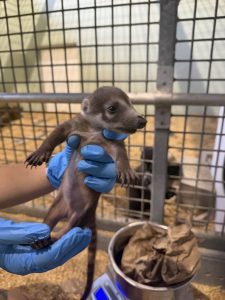
One of Romi’s kits receives a physical examination (image courtesy of Curator of Animals Sidnee Helton)
Let’s give a warm welcome to the new kits on the block!
White-nosed coatis Romi and Rita have recently each welcomed their own litters of kits behind the scenes! While coati Sky also gave birth, her kit was unfortunately stillborn.
These births are all part of the Association of Zoos and Aquariums (AZA) Species Survival Plan (SSP), a program designed to safeguard the populations of animal species within AZA-accredited organizations to protect their native counterparts.
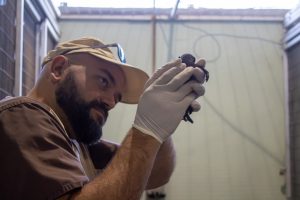
Staff Veterinarian Dr. Garrett Crooks examines one of the week-old kits
White-nosed coatis face habitat threats like hunting and deforestation in their Central and South American native ranges, leading to an overall decline in their populations — that’s why every kit is a win in preserving this incredible species. Moreover, welcoming new coatis each year helps us better understand the social dynamics needed for successful pairing and how to raise young kits.
Each coati birth is carefully planned and coordinated between our director of animal programs and white-nosed coati AZA SSP coordinator and studbook keeper, Lauren Hinson, and other AZA-accredited organizations that are home to the species.
So far, the kits have been doing well in a behind-the-scenes space with their mothers. To prepare Romi for her first birth, we acclimated her to her birthing space ahead of time to ensure she felt comfortable and relaxed.
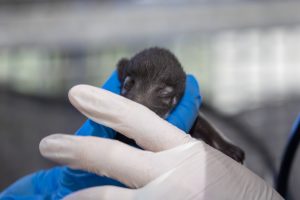
White-nosed coati kits open their eyes for the first time at around 10 days old.
In previous years, Tito was our sole sire for all our kits. But this year, we approached things a little differently.
Onyx the male coati joined our Zoo family last November in a decision to promote more genetic diversity in this year’s kits. Genetic diversity, in general, is important for mitigating disease, adapting to changing environments and ensuring the longevity of a species for years to come. Onyx sired Romi’s kits, while Tito again sired Rita’s and Sky’s kits.
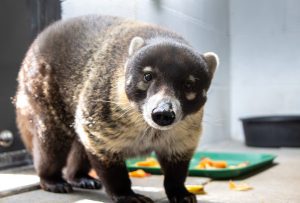
This is Onyx!
“The coati population in AZA organizations has been slowly increasing as we have had births,” said Curator of Animals Sidnee Helton. “The goal is to increase diversity through the AZA population, and we have accomplished that by having successful breeding with Onyx.”
For now, the kits will remain in a behind-the-scenes space where we can closely monitor their growth over the next months. The babies will receive their first set of vaccinations at 8 weeks and their second set at 12 weeks. After that, they’re ready to venture out to their Rainforest Revealed habitat.
Stay tuned to our social media channels and blog to be the first to know when these adorable kits join the rest of our coati band!
We would like to thank the following generous donors for supporting our mission-based programs:
Flammio Financial Group · Stifel- Garvin Wealth Management Group · Artemis IT · Pepsi Bottling Company · Amazon · PCL Construction | Nassal | MEC | Heard