
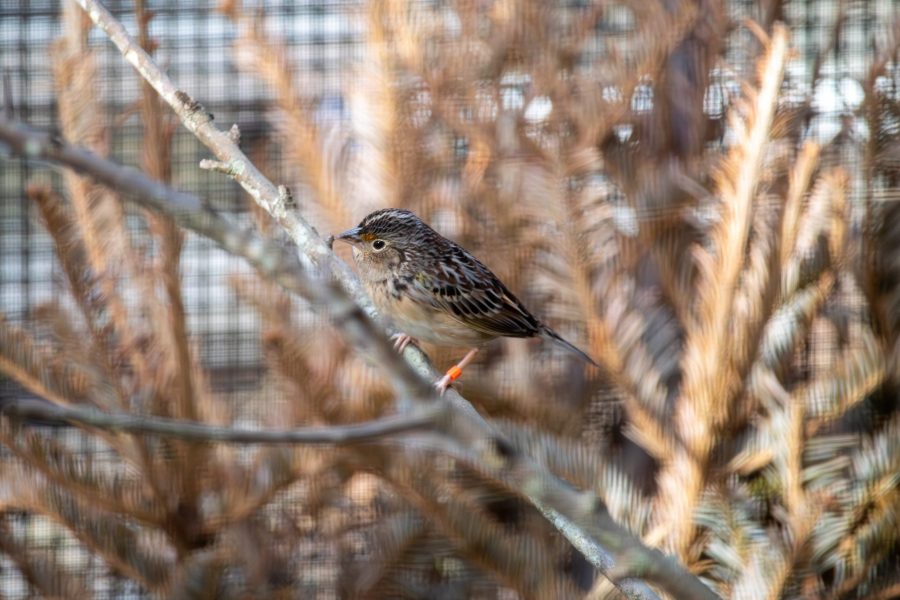
One of our adult Florida grasshopper sparrows!
A little bird told us that Florida grasshopper sparrow nesting season has begun – and we welcomed four chicks recently! Every birth is so important for this critically endangered species as we work with our conservation partners to increase their population.
A decade ago, a little over 100 members of this species were found in their natural range. A collaborative conservation effort to save this species began with partners made up of our Zoo, White Oak Conservation, the Florida Fish and Wildlife Conservation Commission, United States Air Force, U.S. Fish and Wildlife Service and Archbold Biological Station.
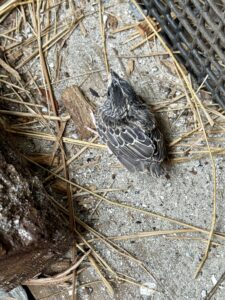
A Florida grasshopper sparrow chick!
These four chicks were hatched by mom Phoenix and dad, Rowan. In early chickhood, they spend their days clumsily exploring the habitat with their parents, said conservation zoologist Kelly Currier. They do a lot of climbing on the plants and branches and testing their wings a bit.
“Their parents call for them, and they call back in an echolocation sort of way, and they are delivered food straight to their spot from their parents,” Kelly said, adding, “Lucky kids!”
East Coast Zoological Foundation’s Conservation team supports these chicks and their parents sprinkling vitamins and minerals like Calcium and Vitamin A on their live bugs, which our team supplements with “sweeps” of wild bugs from central Florida grasslands so their nutrition can be even richer.
“Other than diet, we provide them with extra quiet and alone time during breeding season to keep any potential stress low,” Kelly said. Our Florida grasshopper sparrow families live behind-the-scenes at Brevard Zoo.
These chicks and any others hatched this year may be released or may remain in human care to stay within the Florida Grasshopper Sparrow Working Group to act as new breeding pairs with different genetics.
In addition to Roman and Phoenix, our other pairs this year include Jack the Sparrow and Peggy; Porg and Ava; and Yeti and Nessi. While sunlight, temperature and seasons typically signal to the birds that nesting season has begun – this may be a unique season! These are all new pairings, and the first season five of our birds are sexually mature – so it may take everyone some time to learn about each other and the “proper” sparrow nesting timeline!
We’re hopeful for another successful season of caring for this incredible species and supporting their populations in their native range! Stay tuned for more updates on our sparrows.